

Learn the word, its form and a way to use it
A useful German flashcard gives you more than a translation. For a noun, you need its article and plural; for everyday use, you need to recognize it in a sentence and hear how it sounds. Wortkarten brings these parts together in a vocabulary app for iOS and Android.
Start with a topic you need this week, such as food, travel or your home. Beginners can work with A1 vocabulary; learners further along can choose sets at A2, B1, B2 or C1. You can also create a personal set from German text you encounter.
What belongs on a German vocabulary card?
- The word and its article: learn der Apfel, rather than just Apfel.
- The plural: die Äpfel. Notice the umlaut as well as the ending.
- A clear meaning or picture: an apple provides a concrete cue for recalling the word.
- An example: Der Apfel ist rot. This means “The apple is red.”
- Audio: listen to the word and sentence, then say them aloud.
Wortkarten cards include pictures, translations and example sentences. Nouns have articles and plural forms. Tap a word, plural or example to hear it in German. The sample sentences in this guide are teaching examples; the app may show different examples for the same word.
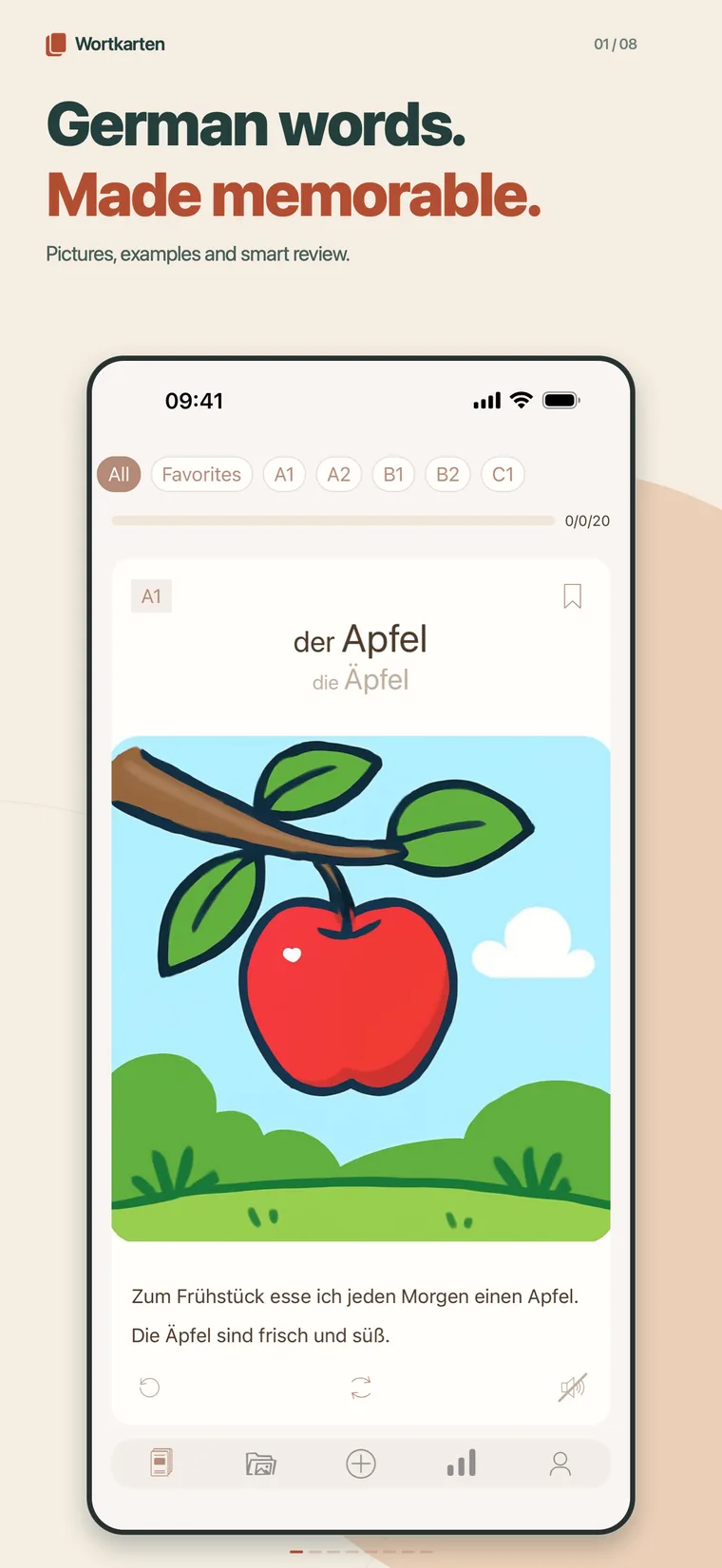
Use pictures as a cue for active recall
Look at the picture and try to say the German word with its article before checking the answer. If you remember “apple” but cannot say der Apfel, that is a part worth practising again. Then reverse the task: look at the German word and recall its meaning.
Pictures work naturally for concrete objects. For less visible meanings, such as “to need”, an example gives you context: Ich brauche ein Ticket. — “I need a ticket.” Try changing one part of it: Ich brauche ein Brot. — “I need a loaf of bread.”
Practise articles and plurals separately
On a small screen, scroll the table sideways to read every column.
| Singular | Plural | Meaning | What to notice |
|---|---|---|---|
| der Apfel | die Äpfel | apple | The plural adds an umlaut. |
| die Wohnung | die Wohnungen | flat; apartment | The plural adds -en. |
| das Zimmer | die Zimmer | room | The noun itself stays the same. |
A correct translation does not automatically mean you know the whole word. After checking the meaning, ask yourself two smaller questions: “Which article?” and “What is the plural?” Review the part you missed.
How spaced repetition fits into German learning
Spaced repetition spreads reviews across separate study sessions. In Wortkarten, your answers guide when vocabulary returns for review. Answer honestly: recognizing a word after seeing the translation is different from recalling it yourself.
Start a session by reviewing the words due for practice. Add a few new words when the existing cards feel manageable, and finish by saying one or two sentences without looking. There is no single review timetable that suits every word and every learner.
Create flashcards from photos of German text
A café menu, a course handout or a short German reading passage can provide words you want to remember. Open the set creation screen in Wortkarten, take a photo or choose one from your gallery, and check the recognized text. Correct any mistakes, give the set a name if you like, then create it.
You can also paste or type text to create a personal word set. Review the cards with pictures, translations and examples, then listen to the German pronunciation. Give the set a name that reminds you where you found the words, such as “At the café”.
For example, a short text about a home could lead you to practise die Küche (kitchen), das Fenster (window) and das Zimmer (room). After reviewing, describe your own room using one of them.
A small routine you can repeat
- Choose relevant words. Start with a topic set or a short text you understand partly already.
- Recall before checking. Try the word, meaning and article, then inspect the answer.
- Listen and repeat. Say a complete example, not only the isolated noun.
- Record an honest answer. Let your reviews reflect what you can actually recall.
- Use a word outside the app. Write a sentence, ask a question or identify something around you.
See what you have started and mastered
Wortkarten shows learning progress by level and within sets. See which words you have started practising and which you have mastered in the app, then choose what to work on next. Try using a new word in a conversation or a sentence of your own.
For a starter vocabulary list with translations, articles, plurals and original examples, see our German-language A1 guide. Its basic word forms were checked against the Goethe-Institut A1 word list (PDF). Use vocabulary practice alongside reading, listening, conversation and grammar study.